
The Cailleach: Ancient Hag, Earth Mother, and Shaper of the Land by Penelope Davis
The Cailleach is one of the most enduring and complex figures in Celtic mythology, a being who stands at the crossroads of nature, time, and transformation. Known variously as The Cailleach Bhéara, The Hag of Winter, or The Veiled One, she appears across Irish, Scottish, and Manx folklore as an ancient female spirit who governs the land itself. In fact, there are some anthropologists who believe that Cailleach was a title more than a deity in her own right. Both feared and revered, the Cailleach embodies the harshness of winter, the wisdom of age, and the raw, untamable power of the natural world.
Name and Origins
The word Cailleach comes from Old Irish, meaning “veiled one” or “old woman.” While the term can simply refer to an elderly woman. However, in myth it becomes something far greater, a primal goddess whose age is immeasurable. The Cailleach is inseparable from the land. Mountains, lochs, storms, and barren fields are all expressions of her presence.
Her stories likely predate Christianity by millennia making her one of the primordial deities within Celtic culture, emerging from early animistic beliefs in which the landscape itself was alive and conscious. Other deities that are considered primordial are the Morrighan, Badb, Cernunnos, The Dagda, etc. Over time, as religious and cultural systems changed, the Cailleach survived not as a polished goddess of a pantheon, but as a powerful folk memory.
Shaper of the Landscape
One of the Cailleach’s most striking roles is that of creator and shaper of the land. Across Scotland and Ireland, countless mountains and rocky formations are said to have been formed when she dropped stones from her apron or basket. Ben Nevis, the highest mountain in Britain, is sometimes linked to her, as are many jagged peaks and ancient hills. Giants Causeway is also associated with stories about the Cailleach. These stories reflect an understanding of nature as something forged by conscious, deliberate forces.
Queen of Winter
Most famously, the Cailleach is the personification of winter. She rules the cold months, bringing frost, snow, and violent storms. In Scottish lore, she is said to gather firewood to prolong winter. This story plays a major role in Imbolc divination, the root of today’s Groundhog’s Day festivities. If the weather is fair, then the Cailleach will go out and gather firewood, thus lengthening the winter. If the weather is foul, then she will stay in
her home and winter will be shorter.
Depiction:
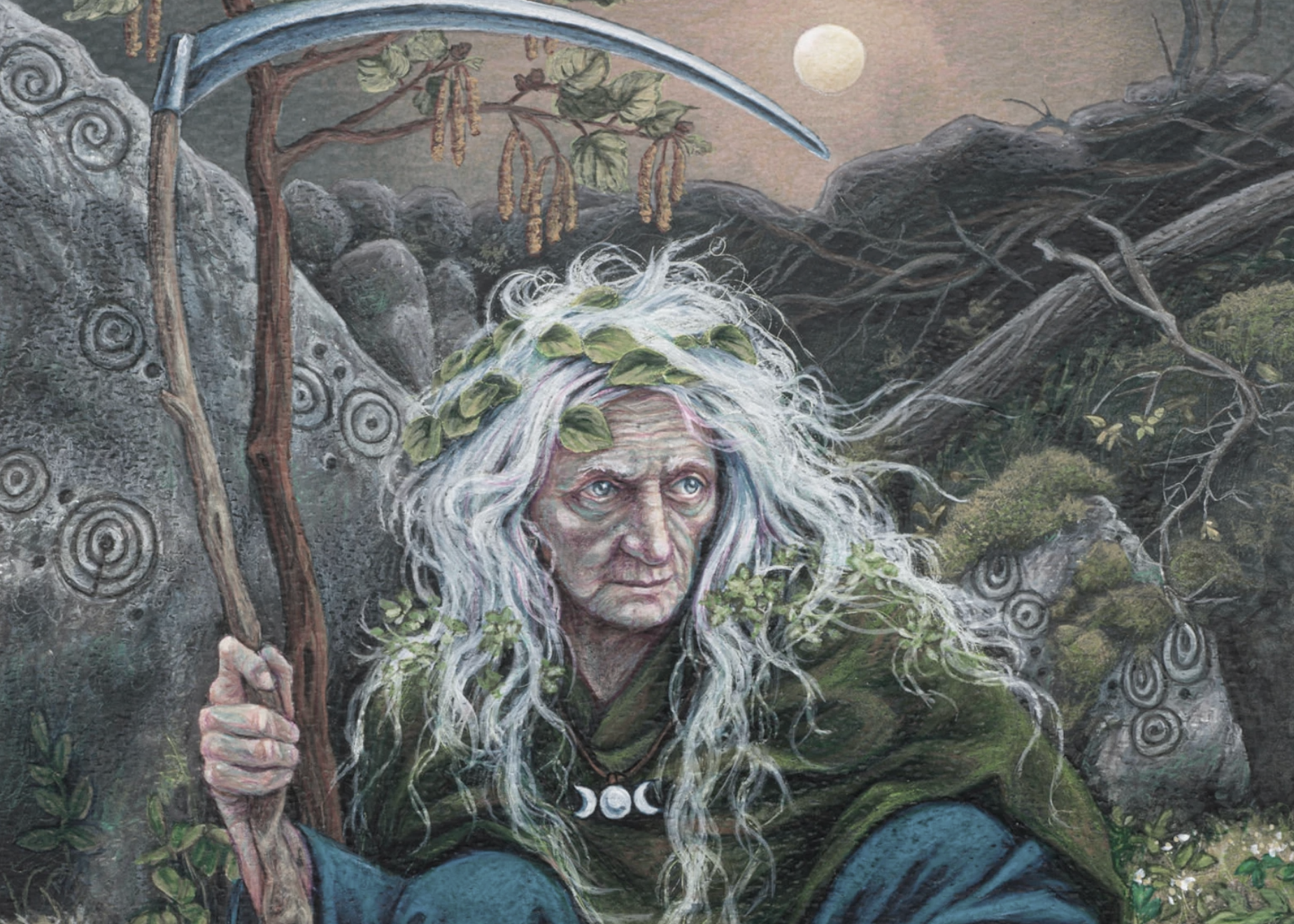
The Cailleach is often depicted as an old woman with blue or gray skin, a single eye, and iron teeth in some traditions. Some traditions depict her sitting on a throne of bones. Yet she is not evil. Winter, under the Cailleach’s rule, is a necessary season of rest, death, and endurance. It’s a time when life withdraws into itself to prepare for renewal.
Transformation and Renewal
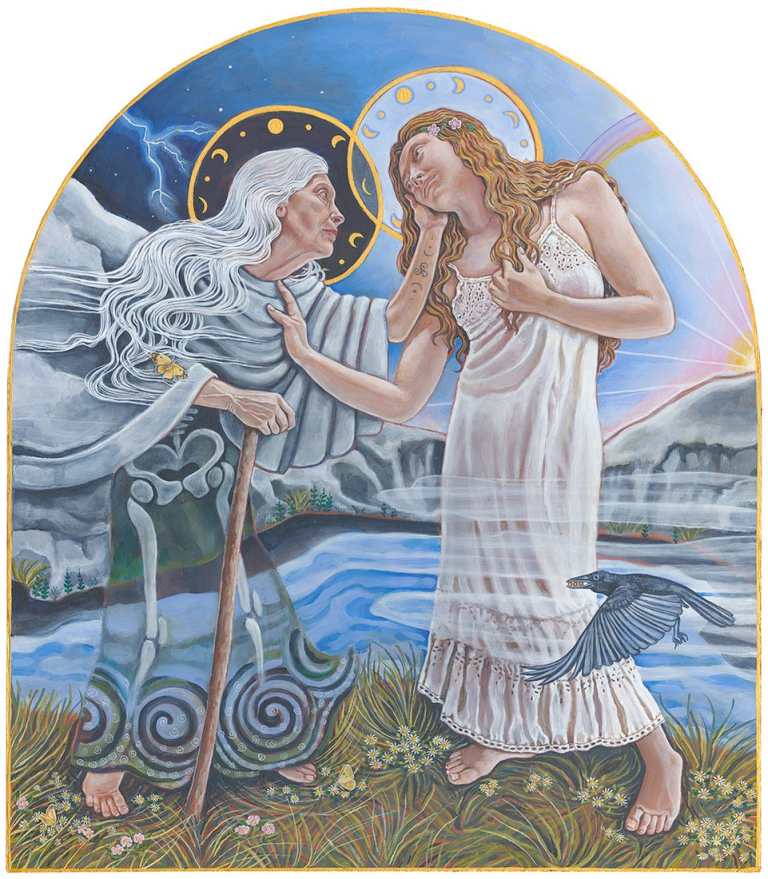
Despite her association with age and barrenness, the Cailleach is also deeply tied to cycles of rebirth. In some Irish legends, she transforms into a young woman at the coming of spring or relinquishes her power to a fertility goddess such as Brigid. In others, she drinks from a magical well that restores her youth. This duality, hag and maiden, destroyer and preserver, suggests that the Cailleach is not merely an old woman, but time itself. And we can see the Indoeuropean links to this and other deities across Europe, the Norns of Germanic Paganism, Elli of Norse Paganism, the Moirei of Greek Paganism, Kali of Hinduism, etc. These deities represent the wisdom gained through endurance, the inevitability of decay, and the promise that decay makes renewal possible.
Sovereignty and the Land
In Irish tradition, the Cailleach also appears as a sovereignty figure. She may offer kingship to a ruler who accepts her in her aged, terrifying form. Only those who can honor the land in all its aspects, fertile and barren alike, are worthy to rule. When accepted, she transforms into a beautiful woman, symbolizing prosperity and rightful kingship.
This motif reinforces a key theme of the Celtic belief that the land is not something to dominate, but something to enter into relationship with. Respect for its harshness is just as important as appreciation of its abundance.
The Cailleach Today
In modern paganism, folklore studies, and ecological spirituality, the Cailleach has experienced a revival. She is increasingly understood as a symbol of wild nature, climate, and the consequences of imbalance. As an ancient earth figure who cannot be controlled or civilized, she resonates strongly in an era of environmental crisis. She also speaks powerfully to contemporary understandings of femininity and age. In a culture that often fears aging women, the Cailleach stands as a reminder that wisdom, authority, and power do not diminish with age, they deepen.
The Cailleach is not a comforting goddess, nor a simple villain. She is stone and storm, winter and memory. She teaches that destruction is part of creation, that endings are inseparable from beginnings, and that the land remembers everything. To encounter the Cailleach in myth is to be reminded that nature is ancient, uncompromising, and alive. That humanity exists not above it, but within it.
How to Honor the Cailleach
I like to feed the birds on Imbolc. You can easily do this with a bird feeder, making pinecone feeders, or just sprinkling birdseed out on the snow.
Spending time in contemplation and reflection. This can be done internally or externally with journaling.
Cleaning up litter and honoring the land.
Expressing primordial rage or grief. This can look like screaming into the void, acts of service for one’s community, or simply sitting with these feelings.
Deliberate day of work and being present with the load that one carries.
The Ár nDraíocht Féin has an invocation for her which can be found here.
Her Altar
I use bones, antlers, stones, and symbols of winter on my altar to the Cailleach. She is associated with the hearth and fire. Candles, lanterns, and wood are aspects of her worship. She is also associated with the harvest, and the Scythe is a symbol that can represent her.
Sources
Newell (1973) “The Divine Hag of the Pagan Celts”, in Venetia Newell, ed., The Witch Figure: Essays in Honor of Katharine M. Briggs, Routledge Kegan Paul.
Scott, & Heather. (2025, March 10). The cailleach – A tale of balance between darkness and Light (part Two). Cailleachs Herbarium. https://cailleachs-herbarium.com/2015/08/the-cailleach-a-tale-of-balance-between-darkness-and-light-part-two/ srsltid=AfmBOoqw0O8wBinD509LHCJndnWpPVjpCNyU5Uds8sAvMFMkB
wYe-MG2
Watson, ‘Highland Mythology’, The Celtic Review Vol V, 1905 taken from
http://www.tairis.co.uk/festivals/la-na-caillich (accessed on the 21/08/15)